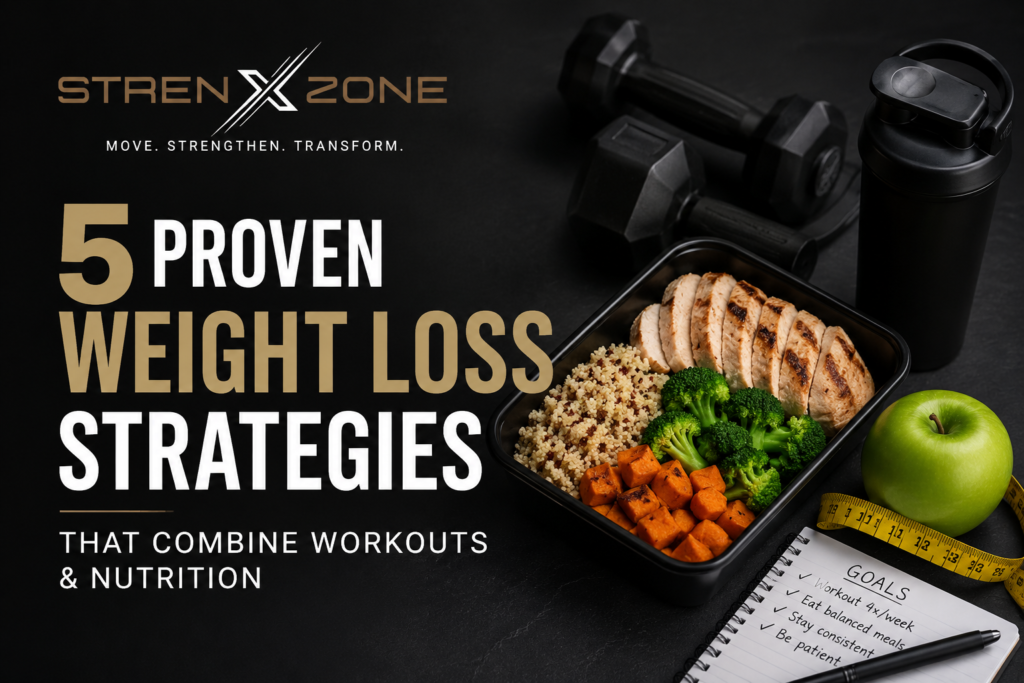
5 Proven Weight Loss Strategies That Combine Workouts & Nutrition
Most people attack weight loss the wrong way — they either live in the gym and eat whatever they want, or they slash calories and skip exercise entirely. Neither approach works long-term. The real secret? Aligning your training and nutrition so each one amplifies the other.
Below are five proven, science-backed strategies that combine workouts and nutrition for maximum fat loss — without burning out or sacrificing muscle.
#1 Build a Calorie Deficit — But Fuel Your Workouts
A calorie deficit is non-negotiable for fat loss. But cutting calories too aggressively tanks your energy, crushes your workouts, and leads to muscle loss. The sweet spot is a moderate deficit of 300–500 calories per day, timed smartly around your training sessions.
- Eat your largest meal 1–2 hours before training for energy.
- Keep carbs around your workout window; cut them earlier in the day.
- Use a TDEE calculator to find your exact maintenance calories first.
Never drop below 1,600 kcal (men) or 1,400 kcal (women) without professional guidance — you’ll lose muscle, not just fat.
#2 Prioritize Strength Training Over Cardio Alone
Cardio burns calories in the moment. Strength training burns calories around the clock by building muscle — which raises your resting metabolic rate. Studies show that resistance training increases post-exercise oxygen consumption (the “afterburn” effect) for up to 48 hours after a session.
- Lift 3–4 days per week using compound movements: squats, deadlifts, bench, rows.
- Keep rest periods short (60–90 sec) to keep heart rate elevated.
- Progressive overload is key — add weight or reps every 1–2 weeks.
Add 2 short cardio sessions (20–30 min HIIT or brisk walk) on top of lifting rather than replacing it. This combo outperforms cardio-only programs for fat loss.
#3 Hit Your Protein Target — Every Single Day
Protein is the most important macronutrient for weight loss. It preserves lean muscle during a deficit, keeps you full longer, and has the highest thermic effect — meaning your body burns more calories just digesting it. Aim for 1.6–2.2g of protein per kg of bodyweight daily.
- Distribute protein across 3–4 meals rather than one large dose.
- Include a 25–40g protein meal or shake within 90 minutes post-workout.
- Top sources: chicken breast, eggs, Greek yogurt, paneer, whey, lentils, tuna.
High-protein breakfasts (eggs, Greek yogurt) significantly reduce overall daily calorie intake by curbing mid-morning hunger spikes.
#4 Cycle Carbohydrates Around Your Training Days
Not all days are equal. On training days, your muscles need glycogen to perform — and carbs are the primary fuel source. On rest days, your demand for carbs drops significantly. Carb cycling matches your carbohydrate intake to your energy needs, keeping fat burning high on off-days while supporting performance on training days.
- Training day: Higher carbs (40–50% of calories) — oats, rice, sweet potato, fruit.
- Rest day: Lower carbs (20–25%) — focus on protein, healthy fats, and vegetables.
- Never cut carbs to zero — energy crashes kill consistency, which kills results.
- This approach also prevents hormonal adaptation that stalls weight loss plateaus.
Time your carb-heavy meals around your workout window. Pre-workout: fast-digesting carbs. Post-workout: complex carbs paired with protein for recovery.
#5 Protect Sleep & Manage Stress to Unlock Fat Burning
You can’t out-train a cortisol problem. Sleep deprivation and chronic stress spike cortisol, which increases fat storage (especially belly fat), drives sugar cravings, and impairs muscle recovery. 7–9 hours of quality sleep is not optional — it’s when your body actually burns fat and repairs muscle tissue.
- Avoid heavy meals and screens 60 minutes before bed.
- Consume casein protein or cottage cheese before sleep for overnight muscle repair.
- Add 10–15 minutes of post-workout stretching or breathing to lower cortisol.
- Track recovery, not just workouts — fatigue is data, not weakness.
Magnesium glycinate (300–400mg before bed) significantly improves sleep quality and reduces muscle cramps for heavy lifters.
Quick Reference Summary
| # | Strategy | Training Focus | Nutrition Focus |
|---|---|---|---|
| 1 | Calorie Deficit + Fueling Workouts | Consistent training output | 300–500 kcal daily deficit |
| 2 | Strength Training Priority | 3–4x/week compound lifts | Adequate calories to lift hard |
| 3 | High Protein Intake | Post-workout protein window | 1.6–2.2g/kg bodyweight |
| 4 | Carb Cycling | High carb on lifting days | Low carb on rest days |
| 5 | Sleep & Stress Management | Recovery-focused weeks | Casein before bed, low cortisol |
Ready to Build Your Fat Loss Plan?
Explore more expert-backed training guides and nutrition resources designed for serious results.
Explore More on StrenxZone →