5 Signs You’re Overtraining (And How to Fix It)
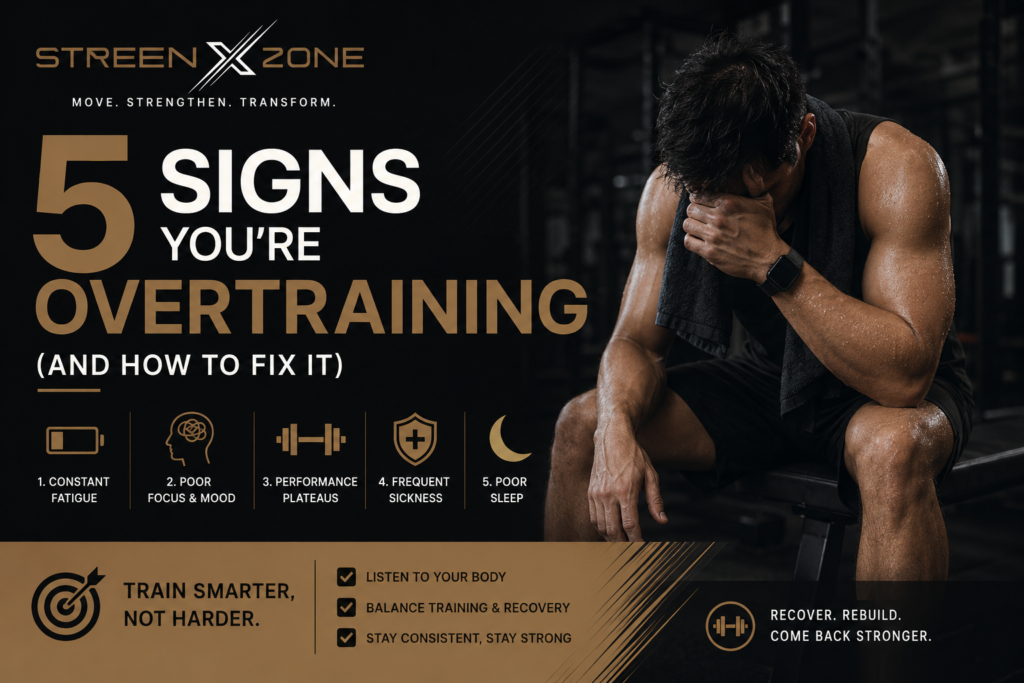
More gym days don’t always mean more gains. Past a certain point, training harder without recovering properly works against you — and most people don’t notice until performance, mood, or motivation starts to drop.
Overtraining isn’t about being weak or lazy. It’s a physical state your body enters when training stress consistently outpaces recovery. The good news: it’s reversible, and it’s easy to spot once you know what to look for.
Here are five signs you may be overtraining, and exactly what to do about each one.
1. Your Strength Is Going Backward
You’re showing up, putting in the work, but the numbers on the bar aren’t moving — or worse, they’re dropping. If you’re lifting less than you did a few weeks ago despite consistent training, that’s not a motivation problem. That’s your nervous system and muscles telling you they haven’t fully recovered from the last session.
The fix: Drop your training volume by 30-40% for one week. Keep showing up, but train lighter. This “deload” week lets your body catch up, and most lifters come back stronger than before.
2. You’re Constantly Tired — Even Outside the Gym
Feeling worked after a hard session is normal. Feeling drained all day, every day, regardless of how much you sleep, is not. Chronic fatigue is one of the clearest overtraining signals, because it means your body’s recovery systems are running in a permanent deficit.
Low energy + poor sleep quality + needing caffeine just to function through the day. Individually these happen to everyone occasionally. Together, repeatedly, they point to overtraining.
3. Your Resting Heart Rate Is Higher Than Usual
Your resting heart rate is one of the most reliable, least subjective signs of recovery status. Check it first thing in the morning, before getting out of bed, for a few days in a row. If it’s consistently 5-10 beats higher than your normal baseline, your body is under more stress than it’s recovering from.
The fix: This is a clear signal to prioritize sleep and reduce training intensity for a few days, not push through it.
4. You’ve Lost the Drive to Train
Motivation dips happen to everyone. But if you used to look forward to your sessions and now genuinely dread walking into the gym — even though nothing in your life circumstances has changed — that’s often a physiological signal, not just a mental one. Overtraining affects hormone balance, including the systems that regulate mood and motivation.
The fix: Don’t force intensity through a motivation slump caused by overtraining. Switch to lighter, enjoyable movement — a walk, a yoga session, light mobility work — for a few days instead of skipping training entirely.
5. You’re Getting Sick or Injured More Often
Catching colds more frequently, or picking up small nagging injuries that wouldn’t normally bother you, is a sign your immune system and tissue recovery are both under strain. Intense training temporarily suppresses immune function — and without adequate recovery, that dip never fully resolves before the next stressor hits.
- Frequent minor illnesses despite no change in hygiene or exposure
- Joint or tendon niggles that linger longer than usual
- Slower healing from minor cuts, bruises, or muscle soreness
How to Recover the Right Way
Spotting overtraining is only half the job. Fixing it means being just as deliberate about recovery as you are about training:
- Build at least one full deload week into your training every 6-8 weeks
- Prioritize 7-8 hours of quality sleep — this is when most physical recovery actually happens
- Eat enough, especially protein, to support the repair your training demands
- Use active recovery (light cardio, stretching, steam room) instead of complete inactivity
- Track your resting heart rate and strength numbers so you catch the warning signs early next time
Training hard is the easy part. Training smart — knowing when to push and when to pull back — is what actually builds long-term strength. Listen to what your body is telling you before it forces you to.
Train Smart. Recover Right. Get Stronger.
Our trainers at StrenXzone help you build a program that pushes your limits without burning you out.
Get Started →