Sleep and Muscle Recovery: The Missing Piece in Your Fitness Plan
Sleep and Muscle Recovery: The Missing Piece in Your Fitness Plan
You can nail every set, every rep, and every meal — but if you’re skimping on sleep, you’re leaving your gains on the table.
Walk into any gym and you’ll hear the same conversation: which protein powder to buy, how many sets for chest day, whether cardio kills gains. What almost nobody talks about is the one recovery tool that’s completely free and available to every single member — sleep. At StrenXzone, we see it all the time: dedicated members training hard five or six days a week, eating clean, but still hitting plateaus. More often than not, the missing piece isn’t in the gym at all. It’s in the bedroom.
Why Sleep Matters More Than You Think
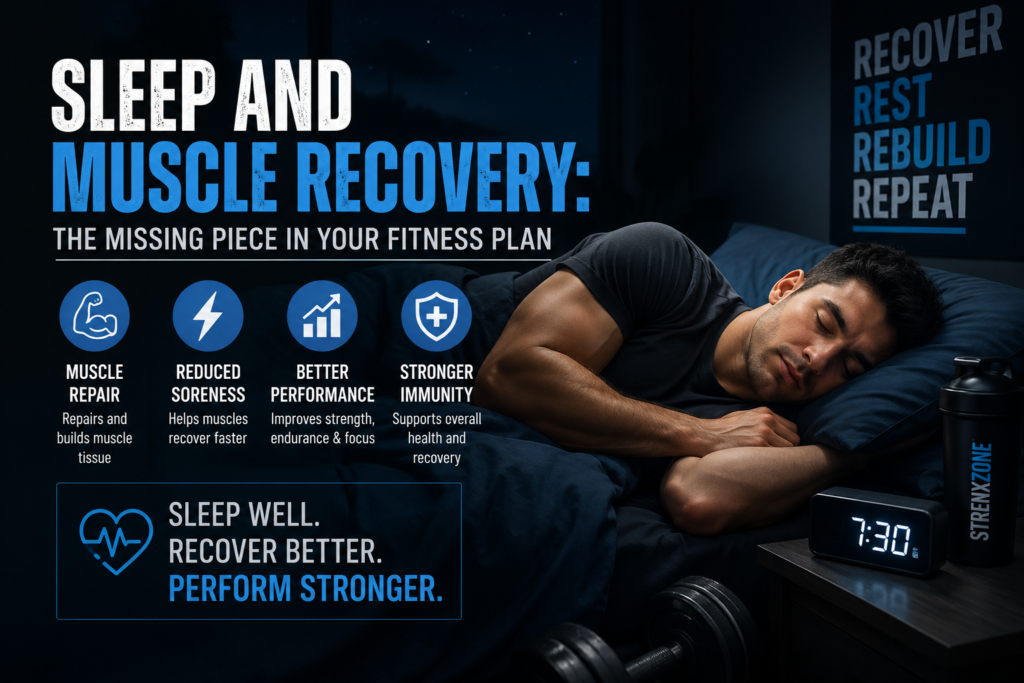
Training breaks your muscles down. Recovery is what builds them back up, stronger than before. That entire rebuilding process — repairing muscle fibers, replenishing energy stores, and regulating the hormones that drive growth — happens mostly while you’re asleep, not while you’re lifting.
The Hormone Connection
Growth hormone, the key driver behind muscle repair and fat metabolism, is released in pulses throughout the night, with the largest spike tied to deep sleep. Cut your sleep short, and you cut this process short too. At the same time, poor sleep pushes cortisol — your primary stress hormone — higher, which works directly against muscle growth and can encourage fat storage, especially around the midsection.
Sleep and Testosterone
Testosterone plays a major role in strength and muscle development for both men and women, and it’s closely tied to sleep quality. Consistently getting less than six hours a night has been linked to measurably lower testosterone levels, which translates to slower strength gains, longer recovery times, and reduced training capacity over weeks and months.
What Happens When You Don’t Get Enough Sleep
- Slower muscle repair: Less time in deep sleep means less time for your body to rebuild damaged muscle tissue.
- Reduced strength and power output: Sleep-deprived lifters consistently underperform on strength and endurance benchmarks compared to well-rested ones.
- Higher injury risk: Fatigue slows reaction time and reduces coordination, making form breakdowns and injuries more likely.
- Increased cravings: Poor sleep disrupts hunger hormones, making it harder to stick to your nutrition plan.
- Weakened immune function: Frequent illness means missed training days and lost momentum.
The Overtraining Trap
Many members who feel constantly fatigued or stuck at a plateau assume they need to train harder. Often, it’s the opposite — their body is asking for recovery, not more volume. Before adding another session to your week, check your sleep first. It’s frequently the real bottleneck.
How to Build Better Sleep Habits
1. Keep a Consistent Sleep Schedule
Going to bed and waking up at roughly the same time every day, even on weekends, helps regulate your body’s internal clock and improves overall sleep quality over time.
2. Watch Your Evening Nutrition
Heavy meals, caffeine, and alcohol close to bedtime can all disrupt deep sleep. Try to finish your last big meal at least two to three hours before you turn in, and keep caffeine to the morning and early afternoon.
3. Wind Down Before Bed
Screens, bright lights, and high-intensity conversations right before bed can delay your body’s natural transition into sleep. A simple wind-down routine — dim lights, light stretching, or reading — signals to your body that it’s time to shift gears.
4. Time Your Workouts Wisely
Training too close to bedtime can leave your body running hot on adrenaline and core temperature when you’re trying to wind down. If evening sessions are your only option, leave at least an hour or two of buffer before sleep.
5. Create a Recovery-Friendly Environment
A cool, dark, and quiet room supports deeper, more restorative sleep. Small changes — blackout curtains, keeping the room a few degrees cooler, silencing notifications — add up over time.
Sleep Is Training Too
At StrenXzone, we coach our members to think of sleep as part of the program, not something separate from it. The reps you put in during the day only pay off if you give your body the time and conditions to actually adapt. Prioritizing recovery isn’t a step back from your goals — it’s what makes every hard session in the gym actually count.
Train Hard. Recover Smarter.
Our trainers at StrenXzone, Goregaon West, can help you build a training plan that works with your recovery — not against it.
Book a Free Consultation