Rest Days Are Not Wasted Days
You took a day off and immediately felt guilty. That voice in your head whispered: you’re falling behind. That voice is wrong. Rest days are not laziness — they are where real progress actually happens.
Growth does not happen during training. It happens during recovery. Every strength coach and sports scientist will tell you the same thing — skip rest and you are not gaining faster, you are just breaking down a system that never gets to adapt.
What your body is doing on rest days
Far from nothing. Rest days are physiologically active. Here is what is actually happening while you are off the gym floor:
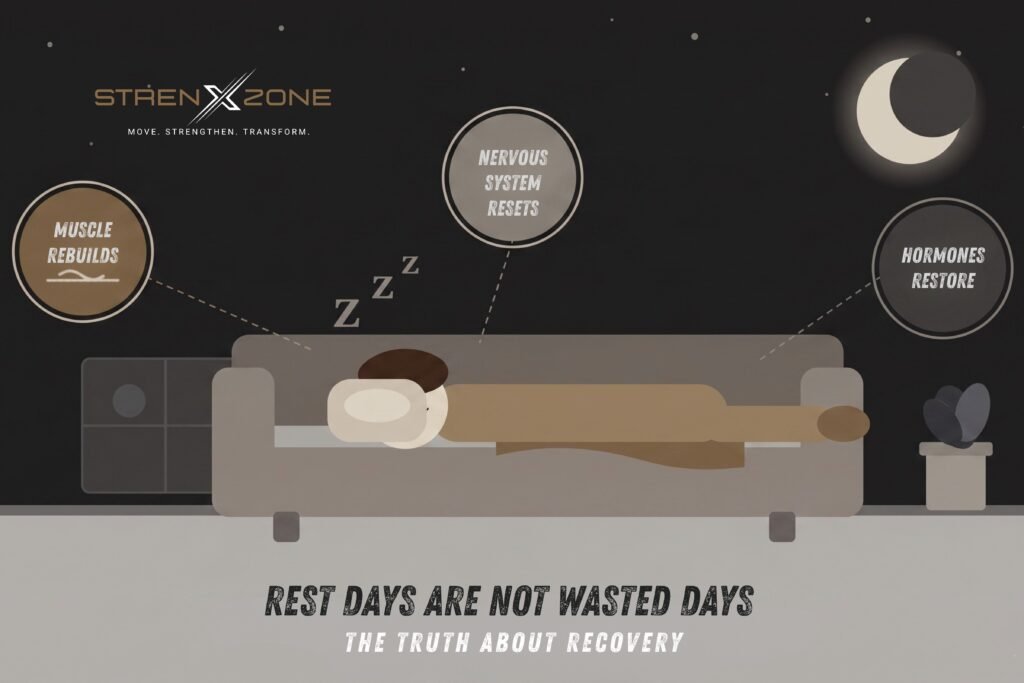
Micro-tears from training are repaired and reinforced — this is the actual mechanism of muscle growth.
Glycogen stores rebuild, restoring the fuel you need for high-intensity effort next session.
Testosterone and growth hormone recover. Cortisol returns to baseline, enabling anabolic conditions.
Your nervous system resets after heavy lifts — why you often feel sharper after a day off.
Signs you need more recovery
Your body communicates clearly when it is under-recovered. Most people have learned to ignore these signals. Do not:
- 📉 Performance declining despite consistent training
- 😣 Persistent soreness that never fully resolves
- ❤️ Elevated resting heart rate (5+ bpm above your baseline)
- 😤 Mood changes — irritability, dread before workouts
- 🤒 Getting sick frequently — overtraining suppresses immunity
“The workout breaks you down. Rest is when your body builds you back up — stronger than before.”
How many rest days do you actually need?
It depends on experience, intensity, and life stress. Here is a simple starting framework:
How to make rest days work for you
Rest does not mean doing nothing. It means directing effort toward recovery inputs:
- 😴Sleep 7–9 hours. Growth hormone is mostly released during deep sleep — this is non-negotiable.
- 🥗Don’t slash calories. Muscle protein synthesis continues 24–48 hours post-training. Keep protein high.
- 🚶Move lightly. A 20-minute walk promotes blood flow without adding training stress — this is active recovery.
- 🧘Manage stress. Chronic stress elevates cortisol and directly impairs recovery. Breathwork and rest are tools.
Rest is part of the work
The gym is where you stress your body. Rest days are where you build it. Embrace recovery — because that is exactly what it is.